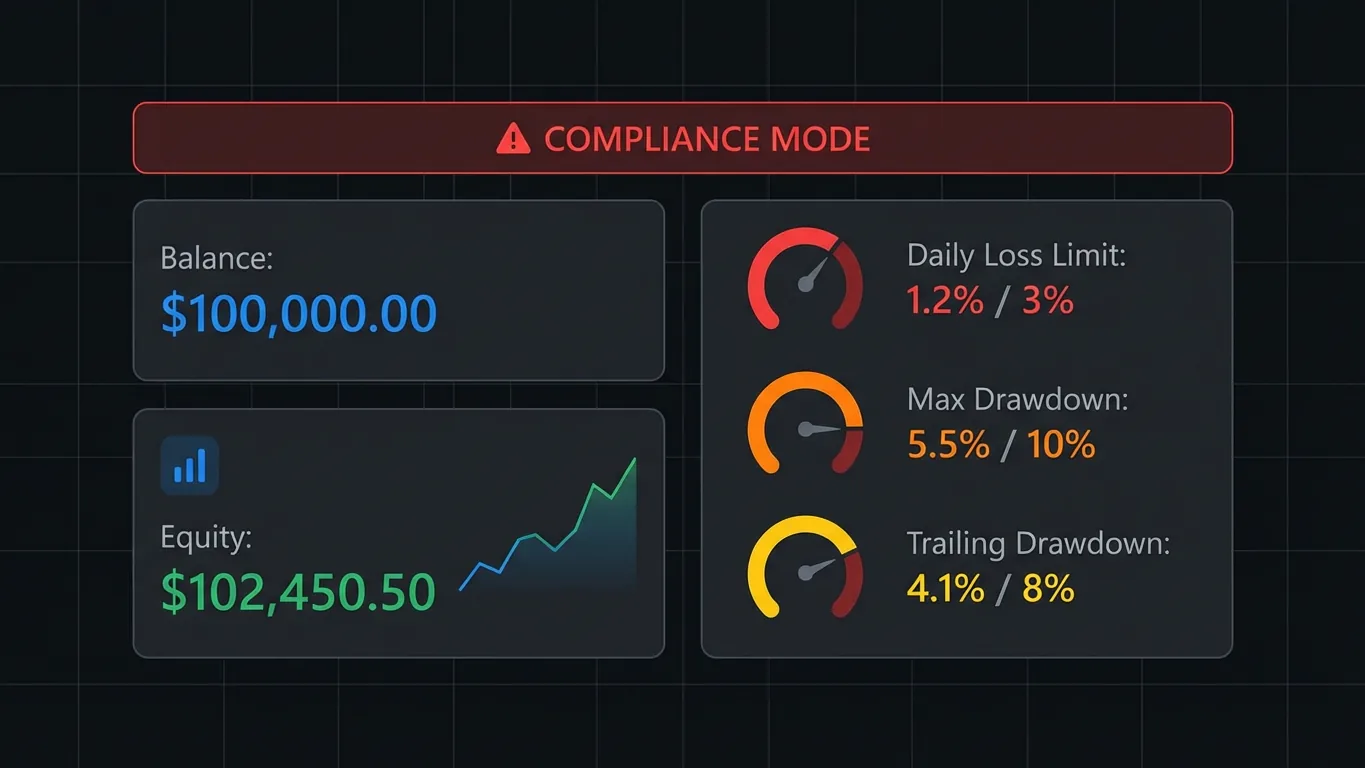
What prop firm drawdown rules really mean (in plain English)
If you trade a prop firm challenge, you’re not only trying to be profitable—you’re trying to stay compliant. Most prop firms define strict loss limits such as:
- Daily drawdown / daily loss limit: maximum allowed loss within a calendar day (or “trading day” per broker time).
- Maximum drawdown: the maximum loss allowed from the initial balance (or a fixed threshold).
- Trailing drawdown (often equity-based): a moving threshold that follows your highest equity or balance.
When traders fail challenges, it’s often not because the strategy is “bad,” but because they violate a rule during volatility, spreads widening, or a string of losses.
This article explains prop firm drawdown rules: how to automate compliance in MT5, from a practical, beginner-friendly perspective—so you can apply the same logic manually or inside an MT5 Expert Advisor (EA).
Important: This is educational content, not financial advice. Always verify the exact rules and time definitions with your specific prop firm.
The 3 most common drawdown types (and where beginners get confused)
1) Daily loss limit (balance-based vs equity-based)
Some firms calculate daily loss from closed trades only (balance-based). Others include floating P/L (equity-based). If you automate compliance, you must decide what you are protecting:
- Balance-based daily loss: safer for firms that only count closed P/L, but you might still breach if a position is closed by stop-out later.
- Equity-based daily loss: stricter and safer because it prevents floating losses from exceeding limits.
For automation, equity-based checks are usually the most robust approach.
2) Maximum drawdown (fixed)
This is typically a single hard stop:
- Example: Starting balance $100,000, max drawdown 10% → do not go below $90,000 (balance or equity, depending on rules).
3) Trailing drawdown (moving threshold)
This is the trickiest rule to automate correctly. A typical version:
- Track the highest equity reached.
- The allowed minimum equity becomes:
highestEquity - trailingAmount.
If you hit a new equity high, the floor moves up. If equity drops, the floor does not move down.
A simple compliance blueprint you can implement in MT5
To automate drawdown compliance in MT5, treat it like a “risk firewall” with three layers:
- Daily loss firewall (resets daily)
- Max drawdown firewall (never resets)
- Trailing drawdown firewall (updates on new highs)
When any firewall is violated (or about to be violated), your system should:
- Stop opening new trades (preferred, least disruptive), and optionally
- Close open positions if the firm uses equity-based limits or you are very close to a breach, and/or
- Trigger alerts/logs so you can audit what happened.
LSI keywords you’ll see naturally in this workflow: daily drawdown limit, maximum loss, trailing drawdown, equity protection, risk per trade, position sizing, compliance automation, prop firm challenge rules.
Practical example (numbers that make the rules obvious)
Assume a $50,000 prop account with:
- Daily loss limit: 5% → $2,500
- Max drawdown: 10% → $5,000
- Trailing drawdown: $3,000 (equity-based)
Your system tracks:
- Day start equity: $50,000
- Current equity: $48,200
- Today’s loss (equity-based): $1,800
Status:
- Daily loss remaining: $700
- Max drawdown remaining: $3,200
Now suppose you earlier reached a peak equity of $52,000. Trailing floor is:
52,000 - 3,000 = 49,000
But current equity is $48,200, which is below $49,000 → trailing rule is breached, even though max drawdown might still be “okay”.
This is why you must model each rule independently.
How to automate compliance in MT5 (EA-friendly logic)
Step 1: Decide what you measure (equity, balance, or both)
In MT5/MQL5 you typically read:
- Balance:
AccountInfoDouble(ACCOUNT_BALANCE) - Equity:
AccountInfoDouble(ACCOUNT_EQUITY)
If the prop firm is ambiguous, equity-based protection is safer because it includes floating P/L and helps prevent accidental breaches during fast markets.
Step 2: Define your rule inputs (make them configurable)
Common EA settings:
DailyLossLimitPercentor absoluteDailyLossLimitMoneyMaxDrawdownPercentor absoluteMaxDrawdownMoneyTrailingDrawdownMoney(or percent)UseEquityForChecks(true/false)BrokerDayRolloverHour(if you must match a specific “day” definition)ClosePositionsOnBreach(true/false)
Step 3: Track state you cannot “recalculate” reliably later
You usually need to store:
- Day start reference (equity/balance at day start)
- Highest equity (for trailing drawdown)
- Optional: Disable-until timestamp once a breach occurs
This state should persist across terminal restarts. In MQL5, that can be done via:
- Global Variables of the terminal, files, or input-based manual resets.
Step 4: Enforce “no new trades” before the breach happens
Don’t wait for an actual violation if execution slippage could push you over. Instead, define a safety buffer:
- Example: stop trading once remaining daily loss is below 5–10% of the limit, or below a fixed amount.
That’s how experienced traders avoid “death by one last trade.”
Step 5: Block entries and optionally flatten exposure
In an EA, compliance enforcement usually means:
- If
breach == true: do not place new orders. - If
closeOnBreach == true: close open positions (or reduce risk).
If your prop firm uses equity-based drawdown rules, flattening exposure is often the only reliable way to stop the bleeding when volatility spikes.
Common edge cases (where automation goes wrong)
Spread, commission, and swaps
Drawdown is not only about price. Ensure your calculations tolerate:
- commission (especially on low-spread accounts)
- swap/rollover
- spread expansion at session open or news
Equity-based checks naturally include these effects.
Multiple symbols and multiple EAs
If you run several EAs, your compliance module must work at the account level, not per symbol. Otherwise one EA can violate rules while another EA thinks everything is fine.
Trading day definition
“Daily drawdown” might reset at:
- broker server midnight,
- a fixed GMT hour,
- or the prop firm’s own session definition.
If you must match a specific time, build a clear “day rollover” rule and log it.
Netting vs hedging accounts
MT5 can run either model. Closing exposure and calculating risk behaves differently when positions are netted vs hedged—so your “close on breach” logic must be tested on your account type.
A practical workflow for beginners (manual first, then automate)
- Write down the exact prop firm rules (daily, max, trailing; equity or balance).
- Create a small spreadsheet with the three firewalls (daily / max / trailing).
- Apply it manually for 1–2 weeks to confirm you understand the thresholds.
- Then implement the same logic in MT5 as:
- alerts first (notify only),
- then trade blocking,
- then optional forced closing.
This staged rollout aligns with EEAT: it’s evidence-driven, testable, and reduces “unknown unknowns”.