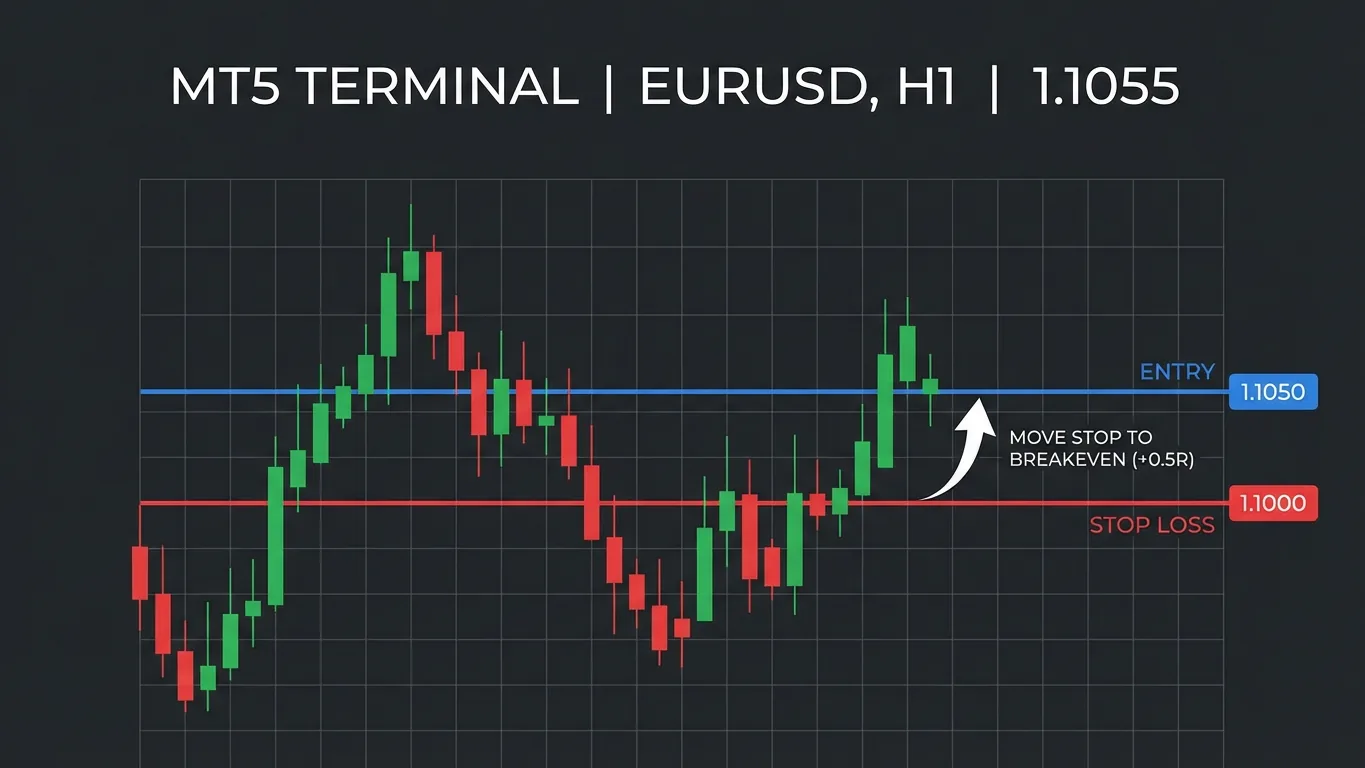
Why this matters (and what “initial risk” actually means)
If you’ve ever moved your stop-loss “because it feels safer,” you already know the problem: discretionary trade management is inconsistent. One of the simplest ways to become consistent is to define breakeven as a rule, not a mood.
In MetaTrader 5 (MT5), initial risk is the amount you would lose if price hits your original stop-loss. You can express that risk in two equivalent ways:
- Money risk: how many dollars/euros you risked (often calculated from a fixed account risk %, like 1%).
- Price distance: how many points/pips your stop-loss is away from entry.
“Setting breakeven based on initial risk percentage in MT5” means you move the stop-loss to (near) entry once the trade has earned a predefined fraction of what you initially risked. That fraction can be expressed as:
- X% of initial risk in money (e.g., move to BE when profit ≥ 70% of risk money), or
- X% of the stop distance (the same idea expressed in points), also known as R-multiples (e.g., 0.7R).
Either way, you get a clean, measurable trigger you can apply manually or in an MT5 Expert Advisor.
The core concept: breakeven as a percentage of initial risk
Define your initial risk (once, at entry)
At the moment you enter a trade you typically know:
- Entry price
- Stop-loss price
- Position size (lots)
- Account risk percentage (optional, if you size positions by %)
From that, you can compute:
- Risk distance (points) =
abs(entry - stopLoss)converted into points/pips - Risk money = “how much you lose at SL” (including spread/commission if you want a more accurate number)
Define your breakeven trigger
Pick a percentage that fits your strategy, e.g. 50%, 70%, or 100% of initial risk.
Examples:
- 50% of initial risk = move to BE at +0.5R
- 100% of initial risk = move to BE at +1.0R
This is the part most beginners miss: the goal is not “never lose.” The goal is to standardize decisions so your results reflect the strategy, not your emotions.
Practical example (numbers you can sanity-check)
Let’s say you trade EURUSD:
- Account: $10,000
- Risk per trade: 1% → $100 initial risk
- Entry: 1.10000
- Stop-loss: 1.09800 (20 pips)
Now you set your rule:
- Breakeven trigger: 70% of initial risk
That means:
- Move to breakeven when floating profit reaches $70, which equals +0.7R
- In distance terms: 70% of 20 pips = 14 pips
So for a buy trade, you move the SL to breakeven when price reaches approximately:
entry + 14 pips→ 1.10140
For a sell trade, it would be:
entry - 14 pips
This is the simplest mental model: your breakeven rule scales automatically with wide or tight stops.
Add a “cost buffer” (so breakeven is truly breakeven)
In the real world, “stop at entry” is not always flat P/L. You have:
- Spread
- Commission
- Swaps (for longer holds)
So a safer approach is: move to BE+buffer, not pure entry.
Common buffer choices
- 1–2 spreads (very common for manual trading)
- Commission in points (important for low-spread commission accounts)
- A small fixed offset, e.g. +1 to +3 pips, depending on symbol volatility
In MT5 terms, for a buy position you’d set:
newSL = entry + buffer
For a sell position:
newSL = entry - buffer
This single tweak can prevent a lot of frustrating “breakeven losses.”
Choosing the right percentage (what experienced traders actually do)
There’s no magic number, but there are patterns:
30–50% of initial risk (0.3R–0.5R)
- Pros: reduces full losses quickly; good for strategies with high win rate.
- Cons: you’ll get stopped out more often before the move develops.
60–80% of initial risk (0.6R–0.8R)
- Pros: a balanced approach; often works well on trending intraday strategies.
- Cons: still vulnerable to pullbacks in choppy markets.
100%+ of initial risk (1R and above)
- Pros: avoids premature BE moves; better for swing trades that need room.
- Cons: you’ll take more full losses before you “lock in safety.”
If you’re unsure, start with 0.7R and adjust after 50–100 trades (or a robust backtest). This keeps you aligned with the EEAT principle: decisions based on evidence, not guessing.
How to implement the rule in MT5 (manual or EA-friendly)
Manual checklist (fast and reliable)
- Place your trade with a fixed stop-loss.
- Measure the entry-to-SL distance (risk distance).
- Multiply by your breakeven percentage (e.g., 0.7).
- When price reaches that level, move SL to entry + buffer (or entry - buffer for sells).
- Do it once. Avoid constantly “micro-adjusting” the stop.
EA logic outline (high-level)
Most MT5 EAs implement this with a few state checks:
- Only manage open positions for the current symbol and magic number
- Store (or re-calc) the initial risk distance from the original SL
- Calculate trigger price:
entry ± (riskDistance * percent) - If current price passes trigger and SL is still “behind” entry, modify SL to BE+buffer
- Do not move SL backwards (ever)
Important implementation details in MT5/MQL5:
- Use the correct Bid/Ask depending on buy/sell when checking triggers.
- Normalize to the symbol’s digits and point size.
- Account for minimum stop levels (broker constraints).
Common pitfalls (and how to avoid them)
- Moving to BE too early: If the market is noisy, you’ll get stopped out repeatedly. Increase the percentage or use a volatility filter (e.g., ATR-based buffer).
- Ignoring costs: Entry-level breakeven can still be a small loss after commissions/spread. Use a buffer.
- Not handling partial closes: If you scale out, your “risk” changes. Decide whether breakeven should trigger before or after partial closes.
- Applying one number to every market: Indices, gold, and FX have very different volatility. Keep the concept consistent, but calibrate the buffer and % per instrument.