Why this comparison matters
Trailing stops are popular because they promise two things every trader wants:
- Protect profits as price moves in your favor
- Let winners run without constant manual management
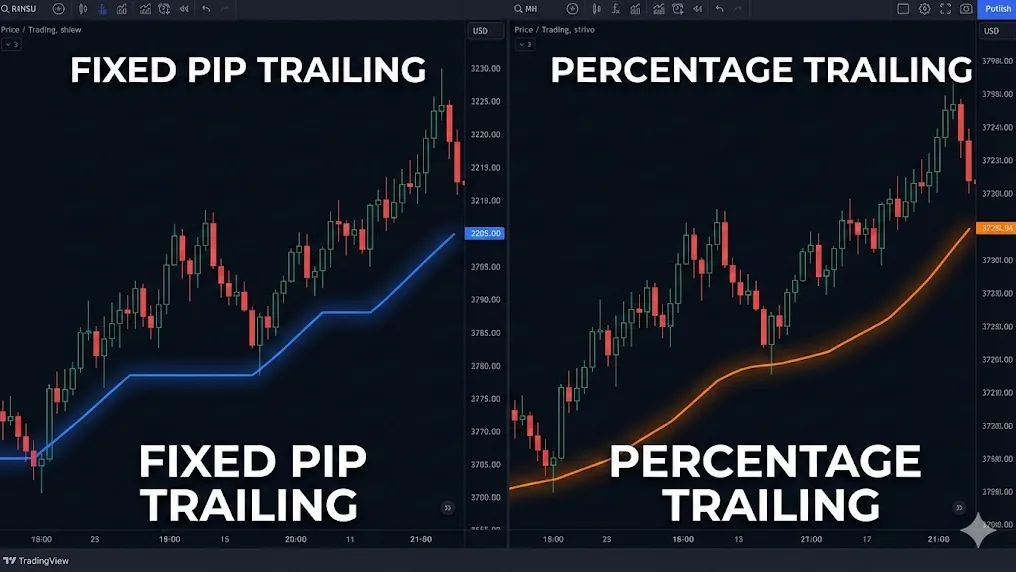
But not all trailing stops behave the same. The difference between fixed pip trailing and percentage-based trailing is not a small technical detail—it changes how your stop reacts to volatility, price level, spreads, and trend speed.
If you choose the wrong trailing method for your instrument or timeframe, you can end up with:
- Frequent “noise stop-outs” (too tight in choppy markets)
- Giving back too much profit (too loose in strong trends)
- A false sense of safety (trailing activates but doesn’t really reduce risk)
This guide explains both approaches in plain English, shows how they behave with concrete examples, and gives practical rules for MT5 traders.
Definitions (simple and precise)
Fixed pip trailing (constant distance)
A fixed pip trailing stop follows price by a constant number of pips/points.
For a buy trade:
- StopLoss = HighestPriceSinceEntry − X pips
For a sell trade:
- StopLoss = LowestPriceSinceEntry + X pips
The key property: the trailing distance stays the same, regardless of price level.
Percentage-based trailing (distance scales with price)
A percentage trailing stop follows price by a percentage of the current price (or highest/lowest since entry).
For a buy trade:
- StopLoss = HighestPriceSinceEntry × (1 − p%)
For a sell trade:
- StopLoss = LowestPriceSinceEntry × (1 + p%)
The key property: the trailing distance changes as price changes. As price rises, the absolute distance (in pips/points) usually becomes larger.
The core difference: constant “pips” vs scaling “distance”
Here’s the simplest way to understand it:
- Fixed pip trailing is instrument-distance based (pips/points).
- Percentage trailing is price-level based (relative move).
That means percentage trailing can behave very differently on:
- Low-priced instruments vs high-priced instruments
- Trending markets vs range markets
- Symbols where the “typical daily range” (ATR) changes a lot
LSI keywords that naturally fit this topic: trailing stop strategy, fixed trailing stop, dynamic trailing stop, percent trailing stop, volatility trailing, ATR trailing stop, profit protection, trade exit strategy, MT5 trailing stop, MQL5 trade management.
Worked example 1: EURUSD (FX, relatively stable price level)
Assume EURUSD is at 1.1000 and you’re long.
Fixed pip trailing: 30 pips
- Trailing distance = 0.0030
- If price peaks at 1.1100, stop = 1.1070
- If price later peaks at 1.1200, stop = 1.1170
Behavior: the stop stays 30 pips behind the best price.
Percentage trailing: 0.30%
At 1.1100 peak:
- 0.30% of 1.1100 ≈ 0.00333 (≈ 33.3 pips)
- Stop ≈ 1.10667
At 1.1200 peak:
- 0.30% of 1.1200 ≈ 0.00336 (≈ 33.6 pips)
- Stop ≈ 1.11664
Behavior: similar-ish to a fixed stop in this narrow range, because EURUSD doesn’t “change price level” dramatically.
Takeaway: On major FX pairs, fixed pips and percent trailing can look similar when price stays in a tight range of levels.
Worked example 2: Nasdaq/US100 (index, higher volatility)
Assume US100 is at 17,000 and you’re long.
Fixed trailing: 100 points
- Distance = 100 points, always
- If peak is 17,300, stop = 17,200
Percentage trailing: 0.60%
At peak 17,300:
- 0.60% of 17,300 = 103.8 points
- Stop ≈ 17,196.2
At peak 18,300:
- 0.60% of 18,300 = 109.8 points
- Stop ≈ 18,190.2
Behavior: percent trailing gradually widens as the index rises, which can reduce noise stop-outs in strong trends—but it can also give back more profit during reversals.
Takeaway: On higher-priced instruments, percentage trailing can become meaningfully looser over time.
Pros and cons (what experienced traders actually consider)
Fixed pip trailing: strengths
- Easy to reason about (“trail by 25 pips”)
- Simple to backtest and compare across trades
- Works well when volatility is stable and the instrument’s typical range is consistent
Fixed pip trailing: weaknesses
- Too tight when volatility expands (news, sessions, regime changes)
- Too loose when volatility contracts (gives back unnecessary profit)
- Requires symbol-specific tuning (25 pips on EURUSD is not the same as 25 pips on XAUUSD)
Percentage trailing: strengths
- Scales naturally with price level (useful on indices, some commodities, some crypto)
- Can stay “proportionally consistent” across different price regimes
Percentage trailing: weaknesses
- Can get looser as price rises (profit give-back grows over time)
- Harder to tune intuition: a small percentage can be huge on some instruments
- Still not volatility-aware (price level is not the same thing as volatility)
A common mistake: using percentage trailing when you really want volatility trailing
Many traders choose percent trailing because they want “adaptive stops.” But percent trailing adapts to price level, not necessarily to volatility.
If what you really want is “trail wider when the market is wild, trail tighter when it calms down,” a better approach is often:
- ATR-based trailing stop (volatility-based)
Example concept:
- Stop = HighestSinceEntry − (ATR × K)
This adapts to the instrument’s typical movement rather than the absolute price level.
Practical MT5 guidance: which one should you use?
Use this checklist as a starting point:
Prefer fixed pip trailing when…
- You trade major FX pairs where price level is stable
- Your strategy already accounts for volatility (e.g., entries filtered by ATR)
- You want a very predictable, mechanical exit
Prefer percentage trailing when…
- You trade instruments where price level changes materially (indices, some commodities, crypto)
- You want trailing distance to scale as price grows (trend-following portfolios)
- You are comfortable with wider give-back in exchange for fewer premature exits
Prefer ATR/volatility trailing when…
- You trade across different symbols/timeframes with varying volatility
- You see frequent stop-outs during volatility spikes with fixed settings
- You want one logic that generalizes better than “pips” or “percent”
MT5 implementation notes (server trailing vs EA trailing)
In MT5 you can implement trailing in two broad ways:
Broker/server-side trailing stop
- Simple to use, runs even if your terminal disconnects
- But capabilities and behavior can vary by broker (and it may not support every custom rule you want)
EA-managed trailing (MQL5)
- Fully customizable (fixed pips, percent, ATR, step trailing, break-even + trailing)
- But it relies on the EA running (VPS recommended) and can fail during disconnects
For sensitive risk control, many traders keep a protective “hard stop” server-side and let the EA handle the more advanced trailing logic on top.
A simple way to choose a starting value (without overfitting)
Instead of guessing:
- Measure typical volatility for your timeframe (ATR or average bar range)
- Pick a trailing distance that is a sensible fraction of that range
- Validate on a meaningful sample size
Examples:
- If ATR(14) is ~20 pips on your timeframe, a 5–10 pip trail is usually too tight.
- If ATR(14) is ~120 points on US100, a 20-point trail is usually too tight.
The goal is not “never get stopped out.” The goal is “get stopped out for the right reasons.”
Call to action
If you want trailing stops, break-even rules, and daily loss limits to be applied consistently (without emotional overrides), take a look at Pro Risk Manager. It’s designed to help MT5 traders enforce clear risk rules so your exits and protection logic stay disciplined across every trade.