Why "prop firm vs individual trading" is not just a preference question
When beginners ask me about prop firm vs individual trading, they usually think it is about "which one makes more money." In reality, it is about which environment fits your current skill level and protects you from the mistakes beginners repeat:
- risking too much after a win (revenge/overconfidence)
- ignoring drawdowns until the account is too damaged
- trading without a clear daily stop
- scaling too early because the first week went well
Both paths can work. The goal is to choose the one that makes good risk behavior easier for you.
LSI keywords you will see in this guide (naturally): proprietary trading, funded account, self-funded trading, retail trader, evaluation challenge, profit split, payout, trading rules, daily loss limit, maximum drawdown, trailing drawdown, consistency rules, position sizing, leverage, risk per trade, account scaling.
Quick definitions (simple and precise)
What is prop firm trading?
Prop firm trading (often marketed as "funded trading") means you trade a firm-provided account after you pass an evaluation challenge. You typically pay a fee, follow strict risk rules, and receive a profit split on gains.
What is individual trading?
Individual trading is self-funded retail trading. You deposit your own money at a broker, keep 100% of profits (minus broker costs), and you set your own rules (which is both the advantage and the danger).
Side-by-side comparison: prop firm vs individual trading
1) Capital and scaling speed
- Prop firm: faster access to larger notional capital (e.g., "50k", "100k", "200k" programs), often with scaling plans.
- Individual: you scale with deposits + compounding, which is slower but "cleaner" and fully under your control.
Beginner reality: bigger capital is only helpful if your risk process is stable. Otherwise, larger size just accelerates the same mistakes.
2) Risk rules (the biggest practical difference)
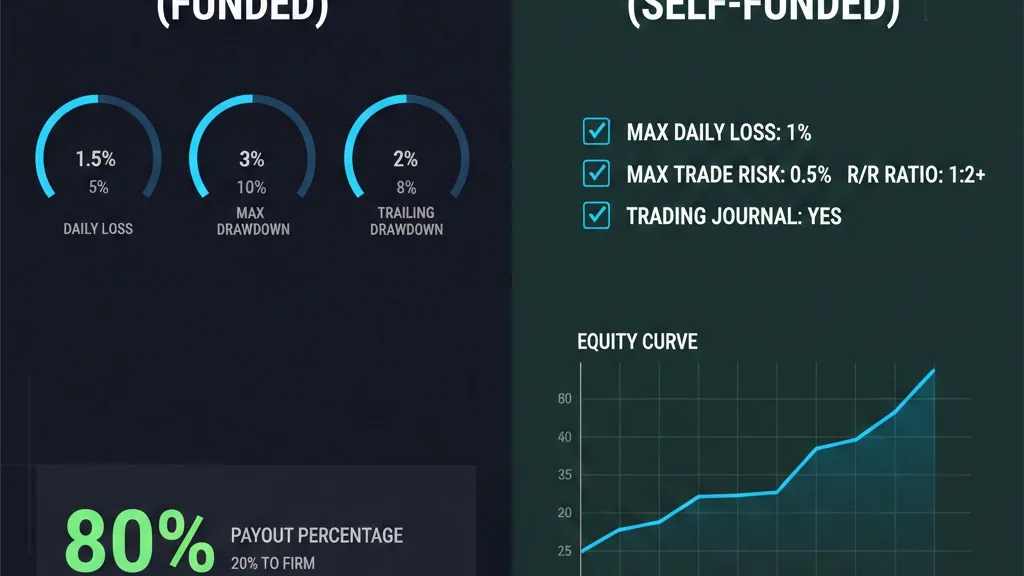
Prop firm accounts usually enforce:
- daily loss limit (balance-based or equity-based)
- max drawdown (often fixed)
- trailing drawdown (often the hardest rule)
- sometimes consistency rules (limits on "one big day" profits)
Individual accounts enforce nothing. You can hold losers, overtrade, or blow up quietly.
If you are still building discipline, prop firm rules can act like training wheels. If you already trade professionally, those same rules can feel restrictive.
3) Costs: fees vs "hidden" friction
Prop firm costs:
- evaluation fees (and sometimes reset fees)
- sometimes higher spreads/commissions depending on the setup
- the opportunity cost of time spent passing challenges vs refining a repeatable edge
Individual costs:
- broker spread + commission + swaps
- slippage and execution quality (depends on broker and market)
- the cost of slow learning if you do not have a strict risk framework
4) Profit split and payouts
Prop firm: you share profits (often a percentage). Payout rules may include minimum days traded, payout schedules, and KYC requirements.
Individual: you keep profits, but withdrawals reduce your account size unless you have sufficient buffer.
5) Freedom and strategy fit
Some strategies do not fit prop firm constraints well:
- high-frequency scalping during volatile news (spread spikes)
- strategies with deep temporary drawdowns
- martingale/grid approaches (often incompatible with drawdown limits)
Self-funded accounts are more flexible, but only if you apply professional constraints yourself.
A realistic example (numbers) to make the trade-offs obvious
Let us compare two beginners with the same skill level.
Scenario A: Prop firm route
- Program: "50k funded"
- Daily loss limit: 5% ($2,500)
- Max drawdown: 10% ($5,000)
- Trailing drawdown: $3,000 (example structure)
- Profit split: 80/20 (example)
If you risk 1% per trade ($500), a normal 5-loss streak (-5%) can hit your daily limit quickly if you overtrade or trade correlated pairs.
What this forces you to learn:
- trade selection (fewer, better setups)
- strict daily stop rules
- reducing size after drawdown
Scenario B: Individual trading route
- Personal deposit: $5,000
- No external rules
If you risk 2% per trade ($100), the same 5-loss streak costs you $500 (-10%). You can keep trading immediately, but many beginners will try to "win it back" and increase risk.
What this forces you to learn:
- patience while compounding
- staying consistent without external constraints
- building a durable risk plan you actually follow
Neither route is "easier." They punish different weaknesses.
The beginner decision checklist (use this before you choose)
Choose prop firm trading if:
- you already follow a daily stop rule and want external enforcement
- your strategy has low-to-moderate drawdowns and clear invalidation points
- you can treat the evaluation as a process, not a casino
- you can handle rules without constantly "fighting the system"
Choose individual trading if:
- you want maximum strategy freedom (holding time, drawdown profile, style)
- you can accept slower scaling while you prove consistency
- you prefer a long-term, low-pressure learning curve
- you are willing to build strict personal rules (and stick to them)
If you feel unsure, start self-funded with small risk for 4-8 weeks. Once your process is stable, a prop firm evaluation becomes much more manageable.
Risk management: how to translate rules into a practical plan (for both paths)
The smartest way to approach prop firm vs individual trading is to focus on the same core controls:
Set your "account-level stops" first
- daily loss limit (hard stop for the day)
- weekly loss limit (optional but powerful for beginners)
- max drawdown limit (the account protection line)
Prop firms set these for you. In individual trading, you must define them yourself.
Keep risk per trade boring
For beginners, "boring" is good:
- 0.25% to 1% risk per trade is usually plenty
- reduce risk after drawdown (do not increase it to recover)
- avoid stacking correlated positions as if they are separate bets
Track equity, not just balance
Many rule violations happen because traders ignore floating losses. Regardless of account type, monitor equity and open risk exposure.
If you trade in MT5, using a dedicated risk manager helps you enforce these limits consistently, especially across multiple symbols and sessions.
Common mistakes I see in prop firm trading (and how to avoid them)
Treating the challenge like a sprint
Most evaluations punish aggression. A "slow and steady" equity curve often wins more than a few huge days.
Not understanding the trailing drawdown rule
Trailing drawdown can fail you even when you think you are "above max drawdown." You must know exactly what the rule trails (balance vs equity) and how it updates.
Risking more because the account is bigger
A 100k account is not permission to gamble. It is permission to apply the same process with more room, not more chaos.