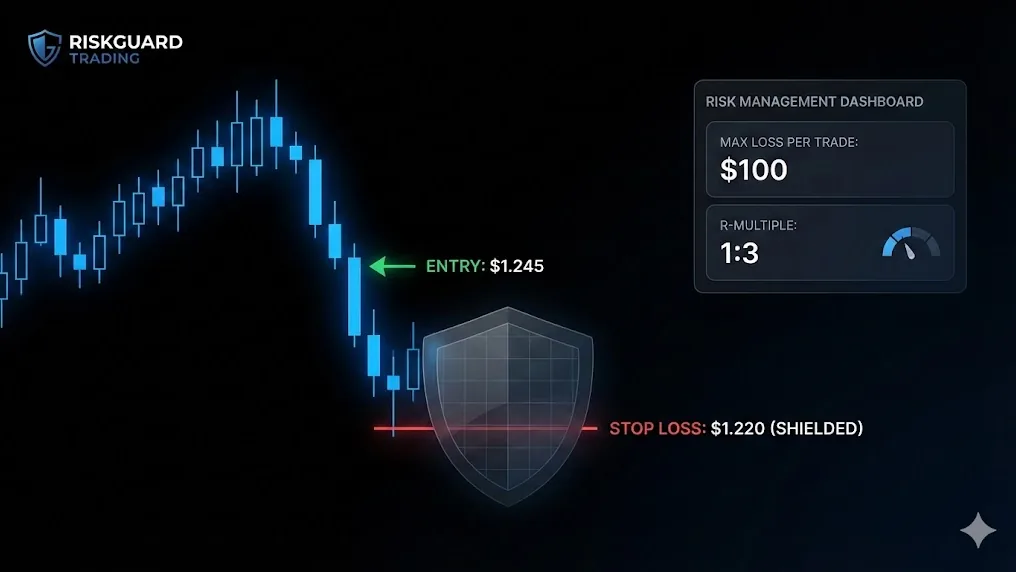
The short answer: it can help, but it’s not a free edge
Many traders ask this because they’ve heard about “stop hunting” or suspect brokers can “see” stops and push price into them. Others simply want to avoid the emotional pain of watching price approach their stop-loss.
Hiding your stop loss can improve trading performance in a narrow set of situations—mostly by reducing self-sabotage (panic exits, premature stop moves, revenge trades). But in many cases it reduces performance by increasing tail risk: gaps, fast markets, internet outages, and execution delays can turn a controlled loss into an uncontrolled one.
The key is to separate two very different ideas:
- Hiding the stop from yourself (psychology / discipline problem)
- Hiding the stop from the market/broker (execution / structure problem)
What “hiding your stop loss” actually means (3 common versions)
1) No stop-loss at all (or “I’ll close it manually”)
This is the most dangerous form. It isn’t “hidden”—it’s missing. If price moves fast against you, you may not get out near the level you intended.
2) A mental stop (manual exit at a price level)
You define a stop level, but you don’t place it on the broker. You watch the market and close the trade when price hits your level.
This can reduce emotional over-management for some traders, but it requires:
- Fast reaction time
- Stable platform and connection
- Clear rules for spikes, spreads, and slippage
3) A virtual/hidden stop inside an EA (server has no SL, EA closes)
In MT5, some traders use an Expert Advisor to hold a “virtual stop-loss” and send a close order when price crosses it. This hides the SL from the broker’s server (the server sees no SL/TP).
It can be useful, but only if you can tolerate the failure modes (terminal offline, VPS issues, requotes, spread jumps, execution delays).
Will hiding your stop protect you from “stop hunting”?
Most of the time, hiding your stop does not solve the real problem.
Here’s the market-structure reality beginners should understand:
- Price often moves to obvious swing highs/lows because that’s where liquidity sits (clusters of stops, breakout orders, and limit orders).
- This is not automatically “manipulation.” It’s often normal price discovery and order-flow dynamics.
- Even if a broker could see stops (they can see orders you send), the bigger issue for most traders is that their stop placement is predictable and too tight relative to volatility.
If your stop is placed at an obvious level (e.g., 1–2 pips below the last swing low on a volatile pair), hiding it won’t change the fact that the market frequently trades through that area.
When hiding your stop loss can improve trading performance
Scenario A: You keep moving stops “because it feels safer”
If your actual leak is behavioral—moving stops farther away, removing stops, or exiting early out of fear—then a “hidden” process can help if it forces discipline.
Example:
- Your plan: risk 1R, stop at structure
- Your habit: widen the SL when price comes close
- Fix: pre-commit the maximum loss and automate enforcement (alerts, hard rules, or an EA)
In this case, “hiding” is really about preventing you from interfering.
Scenario B: You scalp during news/spread spikes and your broker rejects SL updates
Some traders run into practical platform issues:
- Minimum stop distance rules
- Fast markets where modifying SL fails
A virtual stop can provide flexibility, but only if your risk controls are tight and your infrastructure is reliable (VPS, monitoring, logs).
Scenario C: You want to avoid being stopped out by spread, not price
If you trade instruments with frequent spread expansion (especially at rollover), your stop might be hit by spread widening rather than a meaningful move.
The solution is usually not hiding the stop—it’s placing stops based on true volatility and accounting for spread/commission:
- Use ATR-based placement
- Add a spread buffer
- Avoid known spread-expansion windows
When hiding your stop loss usually makes performance worse
1) You trade without a hard maximum loss
The performance you think you gain (“fewer stop-outs”) is often paid back with one big loss that erases weeks of progress.
2) You trade markets that can gap or spike
Indices, crypto, and even FX during high-impact news can jump through levels. If your stop is virtual (or mental), your exit happens after the move, often with worse slippage.
3) Your platform might go offline
If you “hide” stops via an EA but your terminal/VPS disconnects, you are effectively trading with no stop until it reconnects.
A safer approach: keep the stop, improve the stop
If your goal is better trading performance, the highest-impact improvements are usually:
Place stops where your trade idea is invalidated (not where it’s convenient)
Instead of “I’ll put it 10 pips away,” define:
- What market condition proves you wrong?
- Where is the invalidation level?
- Is the distance realistic given volatility?
Size your position so the stop is affordable
If your stop needs to be wider to avoid noise, reduce lot size. Performance often improves when you stop forcing tight stops with oversized positions.
Use consistent R-based trade management
Track outcomes in R-multiples:
- Average R per trade
- Win rate vs average win/average loss
- Maximum adverse excursion (MAE)
This replaces “I got hunted” narratives with measurable data.
Practical MT5 workflow: visible hard stop + automation for discipline
If you’re trading in MT5, a robust middle ground is:
- Place a real server-side stop-loss (so catastrophic risk is controlled even if you disconnect).
- Add automation for consistency: alerts, break-even rules, partial closes, and max daily loss logic.
This approach usually beats pure “hidden stops” because it combines:
- Hard risk limits (safety)
- Reduced discretionary interference (discipline)
How to test whether hiding stops helps your strategy (without guessing)
To know if hiding your stop loss improves trading performance for your system, test it like a hypothesis:
- Define the exact rule variant (mental stop, EA virtual stop, different placement)
- Run a meaningful sample size (not 10 trades)
- Compare: net R, drawdown, worst-case loss, slippage, and rule adherence
If performance improves only because losses are “delayed,” you’ll see it in drawdown and tail events.
Call to action
If you want a safer, more consistent way to enforce stop-loss discipline, risk per trade, and daily loss limits in MT5, take a look at Pro Risk Manager. It helps you apply repeatable risk rules so your performance reflects your strategy—not your emotions. Request a demo or try it on a small account first.