Many traders pick a lot size first and then put the stop loss somewhere that feels acceptable. It works better the other way round: place the stop where your trade idea is wrong, then work out how big the position may be so that a stop-loss hit costs exactly what you planned to risk.
The formula
Position size = (account balance × risk %) ÷ (loss of one lot at the stop)
The first part is your risk amount: 1% of $10,000 is $100. The second part depends on the instrument, and that is where most mistakes happen.
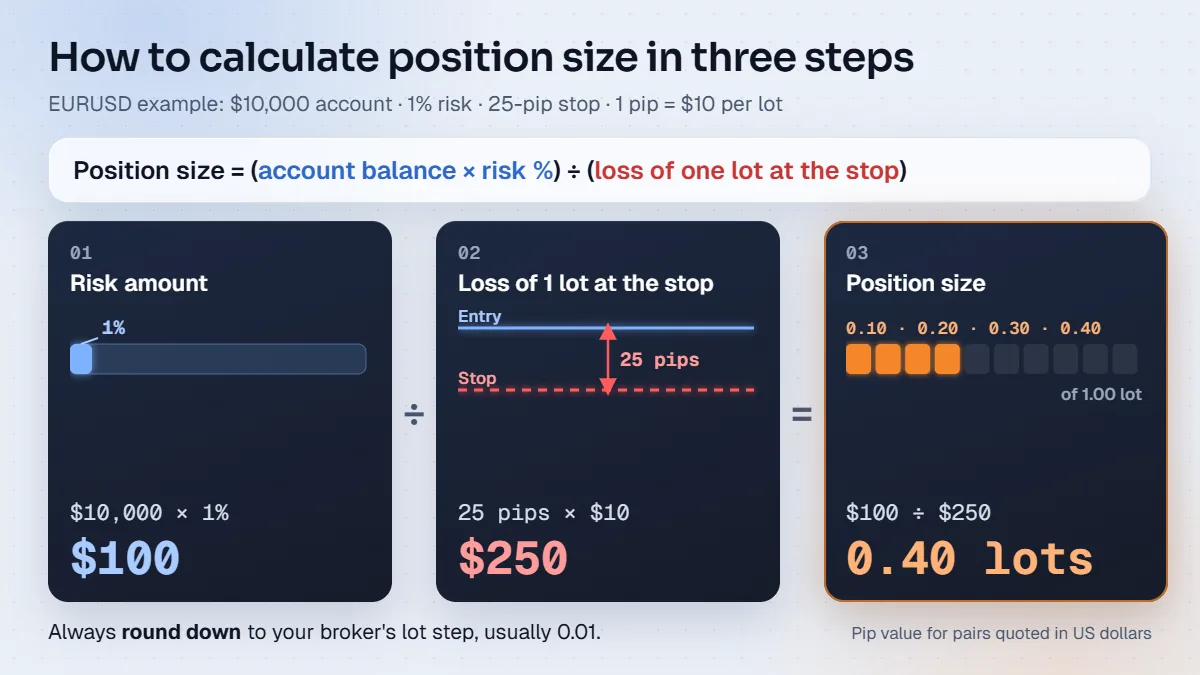 Position size in three steps for EURUSD: $10,000 × 1% = $100, 25 pips × $10 = $250, $100 ÷ $250 = 0.40 lots
Forex: pips and pip value
One standard lot in forex is 100,000 units of the base currency. A pip is the fourth decimal place, or the second for yen pairs.
- Pairs quoted in US dollars (EURUSD, GBPUSD, AUDUSD): one pip is worth $10 per lot.
- Yen pairs (USDJPY, EURJPY): one pip is worth 1,000 yen per lot. On a dollar account you convert at the current rate. With USDJPY at 150.00 that is about $6.67.
- Crosses (EURGBP): the pip value is in the second currency, here pounds. You need the rate from pounds into your account currency.
EURUSD example: $10,000 account, 1% risk, 25-pip stop. The risk is $100, and one lot loses 25 × $10 = $250 at the stop. $100 ÷ $250 = 0.40 lots.
USDJPY example: same account, 20-pip stop, price 150.00. One lot loses 20 × $6.67 ≈ $133. $100 ÷ $133 = 0.75 lots.
Gold (XAUUSD)
For gold it is easiest to work with the price distance in dollars. At many brokers one lot is 100 ounces, so a $1 move changes the value of one lot by $100.
Example: $100,000 account, 1% risk ($1,000), entry at 2,350.00, stop at 2,345.00. The distance is $5, so one lot loses $500. $1,000 ÷ $500 = 2.00 lots.
Check your broker's contract size. MT5 shows it in the symbol specification, and it is not 100 everywhere.
Indices
For indices such as US30, NAS100 or GER40 your broker defines what one point is worth per lot, and in which currency. It might be $1, $10 or €1 per point.
Example: $5,000 account, 0.5% risk ($25), 40-point stop on GER40, €1 per point and lot, EUR at 1.08 USD. One lot loses €40 = $43.20. $25 ÷ $43.20 = 0.578, rounded down to 0.57 lots.
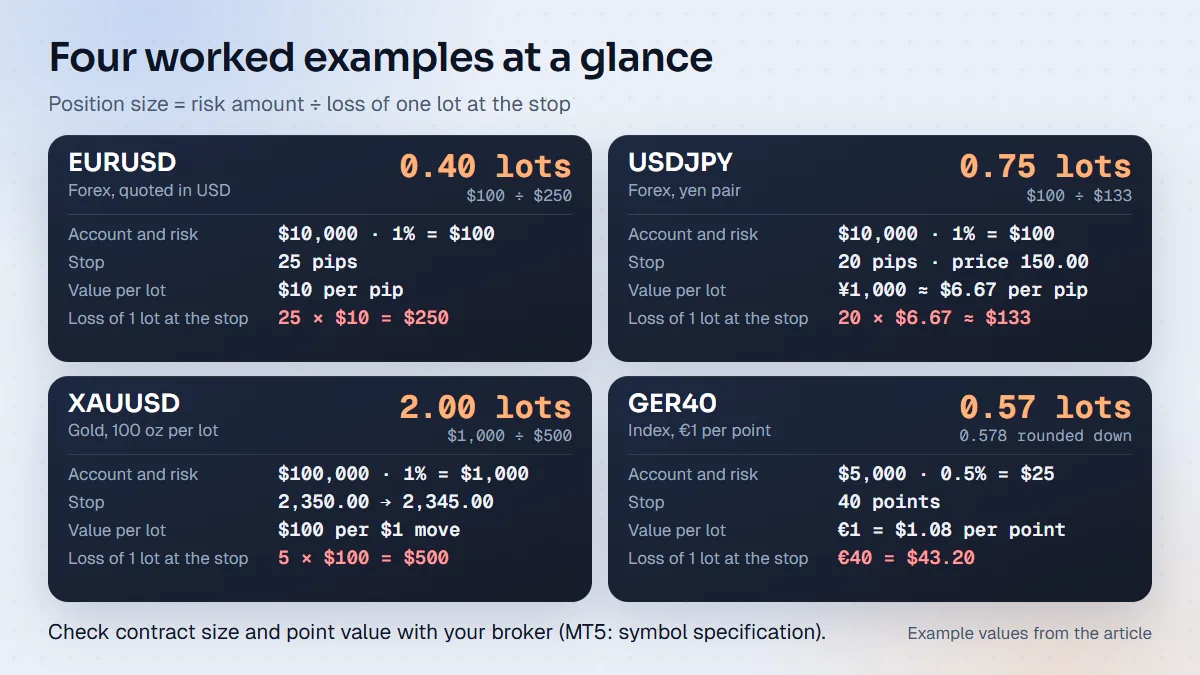 Four worked examples: EURUSD 0.40 lots, USDJPY 0.75 lots, gold 2.00 lots and GER40 0.57 lots, each with account, risk, stop and pip value
Always round down
Brokers usually accept lots in steps of 0.01. If the result is 0.2857 lots, trade 0.28, not 0.29. With 0.28 lots a stop-loss hit costs a little less than planned; with 0.29 it already costs more. If even the smallest lot size is too big, the stop is too far away for your risk.
Common mistakes
- One lot size for every trade. A wider stop with the same size means a bigger loss, so your risk changes from trade to trade.
- Mixing up pips and points. With five decimal places, 10 points are one pip.
- Forgetting the exchange rate. On yen pairs and crosses, the $10 pip value does not apply.
- Ignoring commission. At brokers that charge per lot, the commission adds to the loss at the stop.
Calculator and EA
For quick numbers, use our free position size calculator for forex, gold and indices. It works in USD, EUR or GBP and rounds down to your lot step.
If you trade a prop firm account, also check your risk per trade against the distance to your loss limits. The prop firm drawdown calculator shows where your daily loss limit and max drawdown sit today, and the guide to prop firm drawdown rules explains how they are measured.
In MetaTrader 5, our EA ProRisk Manager does this math for you: you drag the stop-loss line on the chart and the panel shows the lot size for your risk, calculated with your broker's symbol data.